
Work Is Worship
A Manifesto on Matriarchal Leadership

👋 A Low-Stakes Guide to Wonder is back! We’ve found our people, tended our inner world, claimed our peace with boundaries, and made it safe for us to open our hearts. Now what?
Now we shine.
This issue explores the idea of our work as devotion vs hustle. Hustle says your worth is your output. Grind harder, prove more, never rest, never enough.
But labor without belonging isn’t worship or service. It’s cold, hard extraction. Devotion is the opposite. It’s being so completely, unapologetically yourself that the work can’t help but shine.
Turns out, while I’ve been raving about my favorite albums, movies, and novels, I’ve also been accidentally writing a manifesto on matriarchal leadership, and in this issue, I lean in and bring it home.
Exploring the Top 100 albums, novels, and movies has never been a side hustle for me. It’s devotion. Every Meetup is an offering: want to come play with me?
In this issue:
Octavia Butler’s Parable of the Sower and the radical devotion of building something true in the middle of collapse, plus All About Eve, a masterclass in the difference between offering your gifts and weaponizing them. A little Miles Davis along the way too.
The construct underneath hustle culture, and the blueprint for a different way to lead
Podcast & Wisconsin Writers Association news
These times are loud and exhausting in part because the patriarchy is crumbling. You don’t kill it by fighting it. You make it obsolete by building something better.
Let’s play.

🎬📖🎵 Top 100 Exploration: Hands That Build
Three very different shapes of the same question: what is work actually for?
📖 Parable of the Sower by Octavia Butler (FTP List #3)
Lauren Olamina is fifteen when her walled community collapses, and the dangerous world outside finally gets all the way in. She doesn’t survive by becoming less human. She survives by building. Page by page, in a journal she keeps even when it could get her killed, she creates a new belief system she calls Earthseed.
Earthseed’s central tenet is God is Change. Not control. Not conquest. Change. Personally, I find this very appealing. I’ve always cocked an incredulous eyebrow when god is assigned human emotions like “angry” or “jealous”.
But change itself? That I can get a handle on.
Lauren isn’t trying to dominate the chaos around her. She’s trying to move with it, shape it, offer something true into it, and trust that it matters even if no one’s on board yet. That struck me as devotion in its purest form: she couldn’t stop writing about it if she wanted to. She continued making something sacred to her, with no guarantee it would survive.
Butler wrote this in 1993. The world Lauren Olamina navigates was supposed to be science fiction, but today feels closer to a forecast. Here’s what I loved most about this novel. Both women, the writer and her protagonist, were doing the exact same thing.
Lauren builds Earthseed in the middle of collapse, page by page, with no guarantee anyone survives to read it, let alone follow its tenets. Butler built Parable of the Sower over years of day jobs and pre-dawn writing sessions, in an industry that didn’t quite know what to do with her, with no guarantee anyone would listen. Both of them were tending something true because it had to be tended. The work was the worship.
By the end of the novel, Lauren has gathered her people. Not followers in the cult sense. Family. Fellow travelers looking for safety and perhaps some values-led leadership amidst the chaos. That’s another key to “work is worship”. Lauren’s not building an empire. She’s building a web.
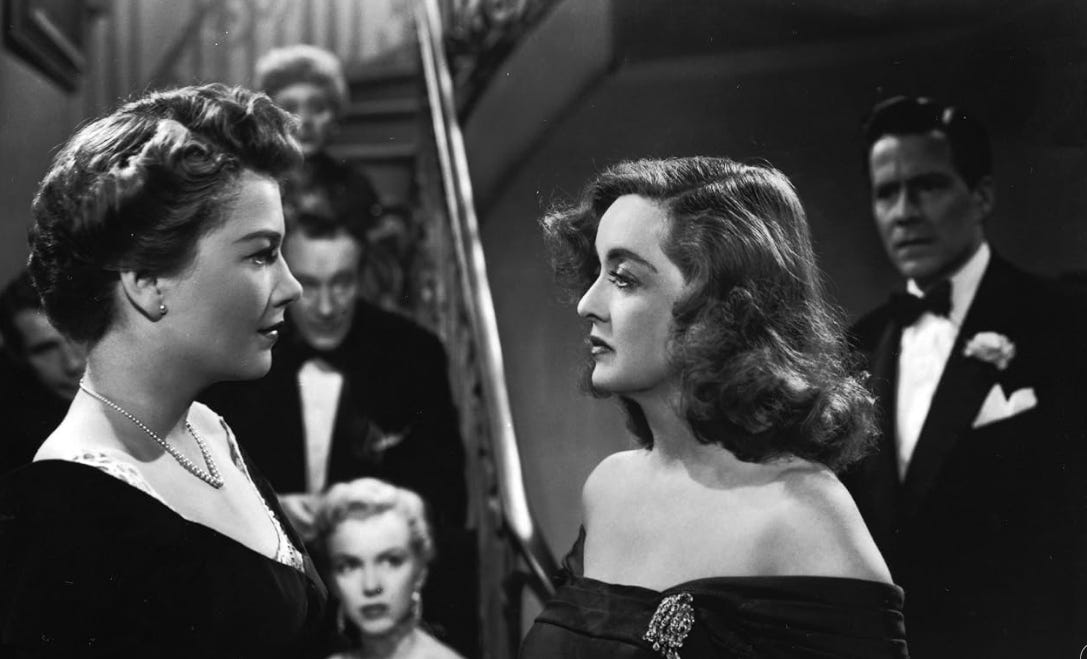
🎬 All About Eve (1950 film, #28 on the Top 100)
This one resists a clean lesson, which is why I love it. The setup is simple: Eve Harrington, young and unknown, attaches herself to Margo Channing, Broadway’s brightest star, under the guise of an adoring fan, then slowly, methodically, and calmly makes herself indispensable until Margo isn’t.
Ambition and devotion have never looked more alike, or more different, than they do in this film.
Margo isn’t innocent, either. Her fear of losing her career isn’t really about whether she’s “good” anymore. It’s about whether she’s seen, wanted, necessary. That’s not pure devotion to craft or to her fans. That’s a woman whose sense of self got fused to her work in a culture that gives women very few other places to put it.
So maybe the real question isn’t who’s devoted and who’s hustling. Maybe it’s whether the system both women are operating within has ever made room for devotion that doesn’t require domination. Eve plays the game because the game is the only stage available. Margo, meanwhile, is terrified of obscurity. She’s been around long enough to know that for women in 1950, relevance has an expiration date.
🎵 Kind of Blue, Miles Davis (1959 album, #31 on the Top 100)
Miles Davis walked into the studio with barely-there sketches and trusted his band to find the rest in real time. The result is the best-selling jazz album of all time. Davis later wrote that no rehearsals were needed. He just stayed open to what his room of great musicians wanted to become. Eve is domination and conquest. Kind of Blue is the opposite. Connection over control, trust over conquest. Unhurried devotion that doesn’t even need words.
🎵 Bonus Listen: The Joy+Soul Experience by Joy + Soul
Joy + Soul is a Houston vocalist, poet, and songwriter who makes music that, in her own words, "gets your head nodding but also speaks to your Spirit." I knew and loved her viral anthem, "I Call My Power Back." But last week, when I was stuck in the gloom, I played the whole album from start to finish, and sure enough it made me feel better. Witchy and empowering.
🔍 Wisdom & Reflection: A Blueprint for Matriarchal Leadership
We took a family trip to Ireland in June, staying in the Connemara region on the Atlantic coast. I spent hours watching the tide move in and out, and then I realized, do I actually know why this happens? In a way that I could explain it to others? Nope. So I looked it up.


The Moon is like a giant magnet for water. It pulls on the ocean, creating an enormous bulge of water on the side of Earth facing it. The moon’s pull also creates a smaller bulge of water on the opposite side of the Earth.
We weren’t witnessing the water moving to and from our shore. We were riding our extraordinary, powerful, spinning Earth through those two bulges caused by the Moon.
Incredible.
The Earth doesn’t do worship. It is worship. Just by being completely, unreservedly itself. That’s the idea behind “work is worship”. It’s not about the work you do. It’s about whether the work is actually you. When those two things are the same, when what you offer is genuinely, irreducibly who you are, that’s when the magic happens. That’s when it stops being labor and starts being something closer to prayer.
Let’s talk about what’s actually underneath hustle culture or “toxic productivity”. Because it isn’t about productivity. It isn’t even really about work.
The framework underneath is dominance. I win, you lose. Your worth is your output. Rest is weakness. Connection is distraction. And if you collapse, you simply didn’t want it badly enough.
When I use the word patriarchy, this is what I mean. Not just male supremacy, but the entire architecture of dominance. It expresses itself through sexism, racial hierarchy, class hierarchy, religious hierarchy, and yes, hustle culture. All symptoms of the same construct.
Any system built on dominance requires violence to uphold it. That’s not strength. That’s fragility.
Once you see it, you will never unsee it. More importantly, you can start deliberately building outside it.
I didn’t intend to write a manifesto on matriarchal leadership, but the first five issues of this newsletter are a blueprint.
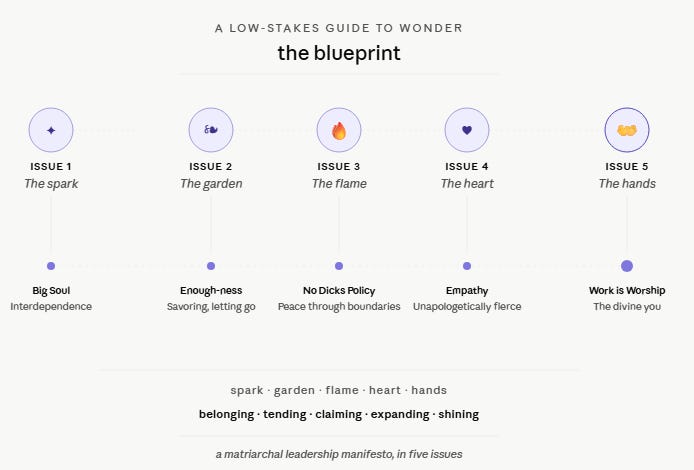
It starts with belonging. You are not separate. You’re a piece of a big soul that belongs to everybody. And once you know that, once you really feel it, you stop trying to go it alone. That’s Issue 1. That’s the first crack in the rot of dominance.
Then you tend. You turn toward wonder, toward presence, toward enough-ness. You stop hoarding and striving and white-knuckling. You learn to savor what’s actually in front of you, and to let go when it’s time. That’s Issue 2. The garden, quietly becoming what it was always meant to be.
Then you protect. Because belonging and tending only work if you’ve created the conditions for them. You draw the line clearly, kindly, and without apology. The No Dicks Policy isn’t a business rule. It’s a philosophy: protect your peace so you can bloom into your full self. That’s Issue 3. The flame that protects its own light.
Then you open. Now that you’re safe, now that you’re tended, now that you have people, you can afford to be generous. Empathy isn’t soft. It’s diabolical in its strength. It transforms people, communities, lives. And it includes the courage to say no when harm is being done. That’s Issue 4. The heart, finally strong enough to stay open.
And then... you shine! Your work is worship when it’s genuinely, irreducibly you. Not performing. Not proving. Just offering. Trusting it will find its people. That’s Issue 5. The hands, open and full.
Matriarchal leadership doesn’t mean women are in charge of everything. That would be another form of dominance.
It’s a different operating system entirely.
Relationship-based instead of transactional. Shared power instead of hierarchy. Leaders as stewards, not commanders.
Like Octavia Butler’s Earthseed, it’s not radical. It’s just true. And the oldest, longest study of human life ever conducted agrees.
The Harvard Study of Adult Development tracked hundreds of people for over eighty years. The single strongest predictor of a long, healthy, happy life wasn’t wealth, status, or achievement. It was the quality of their relationships.
Patriarchy’s dominance has been steering us away from contentment in our own lives. Eighty years of data backs it up.
Or, as I would argue, the wisdom found in the Top 100 albums, movies, and novels backs it up. History is written by the artists, after all. The Harvard Study confirms it.
You don’t have to topple the rot of patriarchy. You just have to build something so much better that it becomes irrelevant. This is the blueprint.
The tide doesn’t chase the shore. The Earth just keeps being the Earth. Unhurried. Moving through the abundance that was already there.
🎙 Mic Check: Podcast & WWA News
Season 4 of Midwest Writers Room has been a good one. This spring we sat with Steven Strackbein, who navigated independent publishing the hard way and then built Sisyphus Triumphant Publishing so other writers wouldn’t have to.
Rebecca M. Zornow, CEO of Conquer Books, writes sci-fi and fantasy for overthinkers and romantics. And yes, she is as delightful as that sounds.
And Alicia Boemi, a self-described literary dabbler, who owns a Lake Geneva bookstore called Lakeside Books, runs a social media storytelling agency called Izzy Works Media, writes children’s books, and has a poetry chapbook dropping this summer. A woman after my own heart.
In June, my co-host and I made the trip to Novel-in-Progress Book Camp. This is a remarkable program, set on the peaceful shore of Lake Michigan, with a whole community of writers practicing the craft. We talked to organizers and attendees, and came away genuinely moved. You can watch the whole thing on our YouTube channel.

What’s new at the Wisconsin Writers Association
☕ Conference Countdown: Conference registration is open, and tickets are selling fast! Join us at the annual writers conference October 23-24 in charming Manitowoc.
📝 Contest News
The Jade Ring, WWA’s annual writing competition, closes August 1. Get that piece of fiction, non-fiction, or poetry polished, and submit. Big thanks to long-time WWA member, literary luminary, and past first-place winner Kim Suhr for organizing this contest for us. Details here.
Here’s another special thing we’ve been working on. We recently ran a Vintage Wisconsin contest in honor of beloved Wisconsin writer Jerry Apps, who passed away late last year. His daughter, Susan Apps-Bodilly, served as judge, and the winners have been chosen. We’re now putting together an anthology of the winning entries, and copies will be available at the conference this fall. I just love everything about this one.
💡 Join Us: WWA is a growing community of writers supporting writers, and we just passed 700 members for the first time! Yay! Membership is just $35/year. If you’re looking for connection, inspiration, and resources to grow your craft, we’d love to have you!
⚡ The Big Reflection
What’s the thing you keep almost doing?
You know the one. The thing you’ve been circling for months, maybe years. The project, the call, the creative leap. The offer you keep almost making.
Your people are already out there. They’re waiting for exactly the thing that is irreducibly, unapologetically you.
Tell me in the comments. I’d love to hear.
⏭ What’s Next
I first read “Work is Worship” when a character in a short story repeated it. The story was published in The Paris Review, and I tried to find it again, but couldn’t. If you are familiar with the story, let me know so I can give the author a shout-out.
I don’t know yet which albums, movies, or novels are calling to me for Issue 6. That’s half the fun. But I do know this: starting next issue, I’m adding a regular segment on matriarchal leadership. Practical, grounded, and art-adjacent as always. If you have a favorite writer or speaker on this topic, put them in the comments.
Stay tuned.
✨ Before You Go
Five issues. A spark, a garden, a flame, a heart, and now hands.
Belonging. Tending. Claiming. Expanding. Shining.
That's the map. And you're already on it. Somewhere between the belonging and the shining, shaky and brave and magnificent.
The Earth doesn’t chase the water. It just keeps being the Earth. Unhurried. Moving through the abundance that was already there.
So do that. Be the Earth. Offer what is irreducibly, unapologetically yours. Trust that your people are already out there.
They are.
Peace,
Luella